
Filling Cups By Bringing Order
When everyone is needy and Mom is maxed out!

In the past couple of weeks, I’ve spoken to a number of mothers who felt like they just weren’t enough for their families and their households. I’m not surprised - this February (especially in the Northeast ) has been long and cold and snowy and we are all feeling the effects of being cooped up, breathing stale air, and longing for even a smidge of warmth and sunshine! And children grow and change, and mothers grow and change and it’s natural that “the way we’ve always done things” should fail at points unless it too grows and changes. That’s not even adding in outside pressures from articles and social media and conversations with well meaning (but maybe bragging a little) moms at co-op, or church, or playgroup!
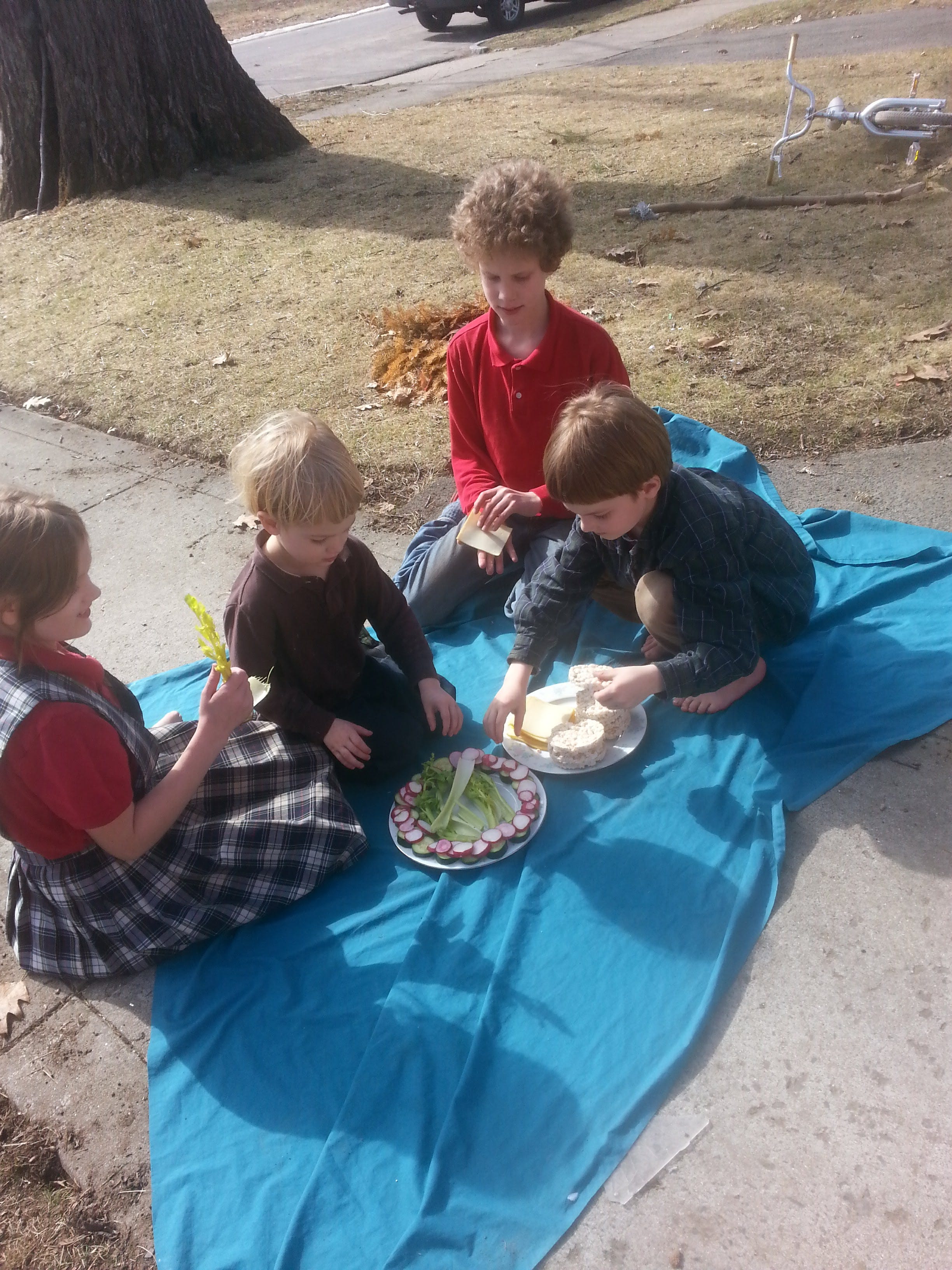
February picnic a few years back
It’s OK.
Of course, you are not enough - no mother is - but perhaps together we can figure out what to concentrate on and what to leave by the wayside.
The question is: What are the priorities and how do we (moms and children) order our days to meet as many priorities as possible?
The first priority is not the children, the lessons (for homeschoolers), or the house. The first priority is Mother. Mother is the heart of the home as Dr. Greg Bottara has argued eloquently here and if she is emanating an atmosphere of peaceful movement through the day the household will also be at peace. So, Mamas, what do we need?
Time to think and plan
A routine to follow
The discipline to return to the plan without beating ourselves up when it is knocked awry
Time To Think And Plan
This doesn’t have to be a whole examination of life and a set in stone plan for the weeks and weeks. Just 10 minutes in the morning or in the evening to reckon up the tasks of the day ahead and the emotional and spiritual needs of the people (including ourselves) will do wonders.
What’s on the calendar? Who has activities? What does that mean for meals?
Here is my thought process last night:
Tomorrow the school children go back to school after winter break, I haven’t been to the grocery because of snow. I’ll make biscuits and hard boiled eggs for them to take for lunch and eat for breakfast.
They will probably be grumpy and a bit slow because of coming off holiday, I may need to pull uniforms for them or spend extra time on emotional support.
Tuesday is our busy evening with activities - I can cook white beans in the crockpot using the broth from Monday’s pot roast and serve them with salad and cornbread.
I have to run a friend to a doctor’s appointment at noon, I can swing by the grocery on the way there and get the things we need for the rest of the week.
If we go swimming after school - I need to pull together their swim gear and bring it with me to the pickup.
This took maybe 10 minutes to think through, check the calendar, and make sure I had the ingredients for lunch and supper. Then in the morning I could focus on keeping the one who had homework company and finding uniforms etc.
No thought involved at this point - just working through the pre-planned list.
A Routine to Follow
Part of the reason the plan above works is that we already have a routine for the mornings and you probably do too!
Our routine looks like this:
4:30-5:30 -Somewhere in that slot I get up. It depends how well I have slept but I do always get up 30 minutes before I wake the children. I am a nicer mother that way.
6:00 -I wake the children and then go back to my morning tea, devotions, writing- wherever I am in that list
6:30ish - children drift upstairs to do homework and/or wake up on the couch. Usually at least one rabbit comes up too for morning zoomies on the parlour rug. If I’m making breakfast I do that.
7:00 - I wake the Big Girl so she can pack lunches
7:30ish - water bottles are filled, bags are packed, last minute things get done
8:00 we walk out the door for school
You also have a routine for the morning - it may be less than ideal but there are already routines and habits for getting up and getting started in the morning and you can start with those and build.
I do think that it is helpful to have a set time that breakfast is over and the tasks of the day are begun. Otherwise the “ideal” routine is whatever suits your families needs at the moment. If there is a particular time that you need to get out the door then plan for that with some extra time for meltdowns and lost shoes. If you are homeschooling, then pick a time that you will begin lessons and that the rest of your morning routine needs to be done (chores, breakfast, hygiene). This is important because clear movement from one task to the next gives a sense of progress and completion to the day. Starting lessons at a particular time also gives you the ability to end them at a particular which helps in the teen years when students are inclined to lollygag. Seeing everyone else be done while you are still sitting at the table working is a strong incentive to developing the self-governance to be diligent.
The Discipline to Return to the Plan Without Beating Ourselves Up When It Is Knocked Awry
This is important.
The plan serves you and not the other way around. The plan gives a structure to return to after the amazing blowout diaper, the dog tracking mud through the house, the total come apart over lost shoes or a sibling’s actions. When the thing has been cleaned up, talked through, snuggled back to peace you get to take a deep breath look at the plan and say, “Okay it’s 10 o’clock, time for a snack (or math or whatever)” and just move back into your day.
This calm moving on helps everyone to regulate. Everyone knows that the next thing is lunch or quiet time or math and so they can relax because life is predictable again. And we can relax too, because we know that whatever was knocked off the schedule by circumstance will come back around tomorrow and can be done then. We don’t have to fret or try to cram something in because there is time enough. Even if what got knocked off the schedule is time sensitive - homework for example- it will be okay. The student can take some time away from their leisure time and do homework (a good lesson) or they can take the poor grade for not turning it in (also a good lesson). The world will not come to an end - they may have angst and tears but they will also see the consequences of actions on their own part (if it was their meltdown over clearing the dishwasher that derailed things) or on the part of others (because sometimes bearing one another’s burdens in love means taking a poor grades because you were comforting your sister over her dead bunny and didn’t finish an assignment).
I think this is the hardest thing of all - but so necessary especially for teens- to hold the schedule as a boundary and allow our children to fail without then pouring words or emotion on the scene.
For example: The day is proceeding nicely through breakfast and morning chores until the baby has a monster blowout. While you are dealing with this the young teen decides to leave unloading and loading the dishwasher (a daily chore) and go off to play a game. By the time you finish with the blowout it is time to leave the house for the school drop-off (or sit down to lessons). Later when lessons are done (or the children are home from school) the teen wants to go off and play, but you say, “ You never finished the dishwasher this morning so you need to do that first.” The teen thinks this is monstrously unfair and carries on, “everyone else is playing!”
“Responsibilities before leisure.” or “Leisure is the reward of diligence” is all you should say. The teen knows they should have done the job, and they know that doing it now is just. They don’t like it but that is their issue with themselves and they must wrestle through it. Your job is to kindly and firmly hold the boundary with as few words as possible. Their “arguing” is not really an attempt to make you change your mind about accountability it is an emotional vent that will escalate if fed and become an argument between conscience and will if unfed. You give the direction and move on to the next thing - keeping an eye out that the task is done and calling the teen back if it is not completed.1 Later you can discuss what happened and what should have happened. You may want to give the child a snack first if they typically have one at that time of day.
My point is that “filling cups” isn’t always done with snuggles and loving words or emotional sportscasting. Often it is the calm repetition of routine and boundaries that makes children feel secure and loved even in the midst of prefrontal lobe development and rapidly multiplying neural networks.
Two things I have found helpful here: children should ask for inspection before dismissing themselves. Jobs done poorly always earn a redo and a second task (this can be very short even a quick 5 minute wipe of the sink) that gives the child the opportunity to do a job correctly from start to finish (and yes some kids will earn a 3rd or even a 4th job before they wise up).
This reminds me of something I read long ago, "You don't tune the violin AFTER the concert." Thanks for your day's organization before the day gets started.